


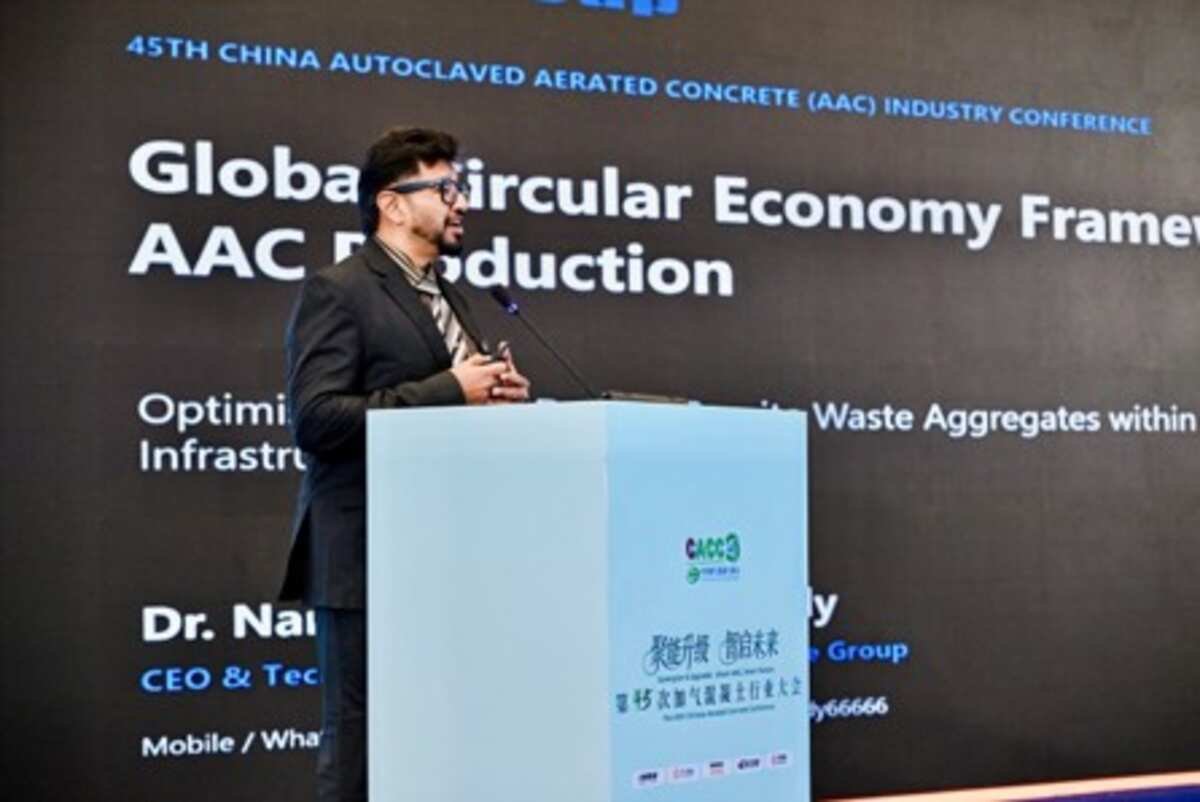
Chengdu presentation explores how quarry dust and granite-processing residues could become valuable resources for sustainable AAC manufacturing
As the construction sector looks for ways to use natural resources more responsibly, the idea of a circular economy is moving from environmental discussion into practical industrial planning. At the 45th China Autoclaved Aerated Concrete (AAC) Industry Conference in Chengdu, Dr. Nandiki Gangadhar Reddy, CEO & Technical Director (India) at Dongyue Group, presented an Indian perspective on how quarry dust and granite-processing waste may be brought into the AAC manufacturing ecosystem.
His presentation, “Global Circular Economy Frameworks in AAC Production: Optimising Quarry Dust & Granite Waste Aggregates within the Indian Infrastructure Ecosystem”, was delivered on 20 November 2026. It focused on an important opportunity for India’s building-materials industry: looking at mineral residues not only as waste to be managed, but also as potential resources that may be evaluated for productive use.
A resource challenge—and an opportunity
India’s infrastructure growth is increasing demand for construction materials and placing pressure on the sourcing, movement and efficient use of raw materials. In several regions, stone crushing, quarrying and granite processing also generate substantial quantities of fine mineral residues. Depending on their source and characteristics, these materials may be stockpiled, moved or disposed of, even when they could have potential value in another industrial application.
Dr. Reddy’s presentation brought these two realities together. It considered whether suitable quarry stone dust and granite-processing powders could be processed and used as alternative mineral inputs in AAC production. The proposition is relevant to regions where mineral-processing activity and demand for modern building materials exist within the same broader industrial ecosystem.
The central circular-economy principle is straightforward: one industry’s by-product may become another industry’s input. Instead of following a linear pattern in which resources are extracted, processed and eventually discarded, businesses can explore ways to retain materials in productive use. This requires cooperation between material generators, processors, equipment providers and manufacturers.
Why AAC is part of the conversation
Autoclaved Aerated Concrete is widely used as a lightweight building material. Its production relies on a carefully managed combination of raw materials and manufacturing stages. That makes the evaluation of alternative mineral resources an important area of interest for manufacturers seeking to improve resource efficiency without compromising product quality.
Quarry dust and granite waste are not uniform materials, and they cannot be assumed suitable for every plant or formulation. Their mineral composition, particle characteristics, consistency and behaviour in a production process need to be understood. The presentation therefore framed resource recovery as a structured industrial exercise: identify the material, assess its suitability, prepare it appropriately and validate its performance within the intended manufacturing process.
This distinction matters. A circular-economy project must do more than move waste from one location to another. It must establish a reliable use for the material, maintain quality and demonstrate that the resulting production arrangement is commercially and environmentally sensible.
From isolated waste piles to local industrial partnerships
One of the wider opportunities is the development of local resource partnerships. Quarry operators, stone-crushing units, granite processors and AAC manufacturers can explore arrangements that connect mineral residues with potential users. Such cooperation may reduce the distance materials travel, create additional value for waste-generating businesses and support more efficient regional supply chains.
For industrial clusters, this approach can also encourage new services and business opportunities around material collection, segregation, processing, testing and supply. It creates a reason for companies that have traditionally operated separately to work together around a shared resource-efficiency objective.
The benefits will depend on local conditions, including the availability and consistency of residues, transportation distances, processing needs, plant capability and the quality requirements of the finished product. A responsible approach therefore begins with local assessment rather than a one-size-fits-all claim.
Dongyue Group’s manufacturing perspective
As CEO & Technical Director (India) at Dongyue Group, Dr. Reddy brought a manufacturing and industrial-systems perspective to the discussion. Dongyue Group is active in building-material production equipment and AAC manufacturing systems. This industry experience provides a context for considering how material preparation, plant integration and production controls can support the evaluation of alternative raw materials.
The presentation connected the potential of quarry dust and granite-processing waste with the broader need for dependable manufacturing. For an alternative resource to be useful at industrial scale, manufacturers need to understand how it can be sourced, prepared, introduced and monitored. Consistency and quality assurance remain essential at every stage.
An Indian perspective with international relevance
Although the presentation focused on the Indian infrastructure ecosystem, the underlying question is relevant to many markets. Countries with active quarrying, stone processing and construction industries face similar questions about how to manage mineral residues and reduce avoidable resource loss.
The Chengdu conference offered a platform to share this perspective with the wider AAC community. By placing circular economy at the centre of the discussion, Dr. Reddy highlighted the value of international exchange: approaches developed for one market may offer useful ideas for another, provided they are adapted to local materials, regulations and production conditions.
Making circular economy practical
The next step for the industry is to turn promising concepts into carefully evaluated applications. This means building reliable data about local waste streams, conducting material testing, establishing quality protocols and developing commercial relationships between suppliers and manufacturers. It also means measuring outcomes rather than assuming that every substitution automatically delivers an environmental benefit.
For Dr. Nandiki Gangadhar Reddy, the opportunity around stone dust AAC and granite waste AAC is part of a larger vision for sustainable construction: making better use of resources already generated by industrial activity and creating stronger links between sectors.
His message from Chengdu is that the future of building materials will be shaped not only by new products and technologies, but also by the industry’s ability to rethink resources. When suitable mineral residues are responsibly assessed and brought into productive use, what was once considered a disposal challenge may become part of a more circular industrial system.
ABOUT DR. NANDIKI GANGADHAR REDDY
Dr. Nandiki Gangadhar Reddy is CEO & Technical Director (India) at Dongyue Group. His professional interests include building-material manufacturing, AAC production systems and circular-economy applications involving quarry stone dust and granite-processing waste. He is focused on exploring practical pathways for using suitable mineral residues in sustainable construction-material production.
Conference information: 45th China AAC Industry Conference
